Dropping to one nap is the biggest schedule change of toddlerhood, and the most commonly rushed. Real readiness usually arrives between 13 and 18 months, with 15 being the median. But the signs of readiness — fighting a nap, skipping one — show up first at 10–12 months as the "false 2→1," a developmental nap strike (standing, walking, separation anxiety) that resolves in two to three weeks if you hold the two-nap schedule.
The difference is age and consistency. A 14-month-old refusing the afternoon nap for two straight weeks is transitioning. An 11-month-old doing the same thing is almost always striking.
A gentle 3-week plan
- Week 1–2: push the morning nap later in 15–30 minute steps every 2–3 days — from ~9:30 toward 11:00–11:30. Offer a snack and some outdoor time to bridge the gap.
- Let it be the only nap on days it runs 1.5 hours or more. Bedtime moves to 6:30 PM on those days.
- Allow two-nap rescue days. If the single nap is short and the afternoon falls apart, offer a 30-minute catnap ending by 3:30 PM. This is not backsliding.
- Week 3+: settle the final form — one nap starting 12:00–12:30, lasting 1.5–2.5 hours, bedtime 7:00–7:30 PM once the nap is long enough.
The false 2→1 at 10–12 months
Around 10–12 months nearly every baby has a two-week stretch of fighting one nap — usually the afternoon one. It coincides with pulling up, cruising, walking and a peak in separation anxiety. It looks exactly like readiness and it is not: a baby this age cannot handle a 5–6 hour wake window and will accumulate overtiredness within days if you switch. Hold the two-nap schedule, cap the morning nap at 60–75 minutes so the afternoon nap has a chance, bring bedtime forward on skipped-nap days, and wait. True readiness rarely arrives before 13 months.
Protecting the nap you have left
The one nap now carries the whole day, so it needs protecting like a bedtime: a dark room, white noise, a short wind-down routine, and a consistent start time within about 30 minutes. Cap it at 2.5 hours (some say 3) so bedtime holds. On a day the nap is short or refused, the answer is always an earlier bedtime — 6:30 PM is fine at this age — never a second nap after 4 PM.
Before and after: sample days
Before: the 2-nap day (12–14 months)
After: the 1-nap day (15–18 months)
Sample days assume a 7:00 AM wake-up. Customize for your baby's wake time →
Transitions are messy.
Your tracker shouldn't be.
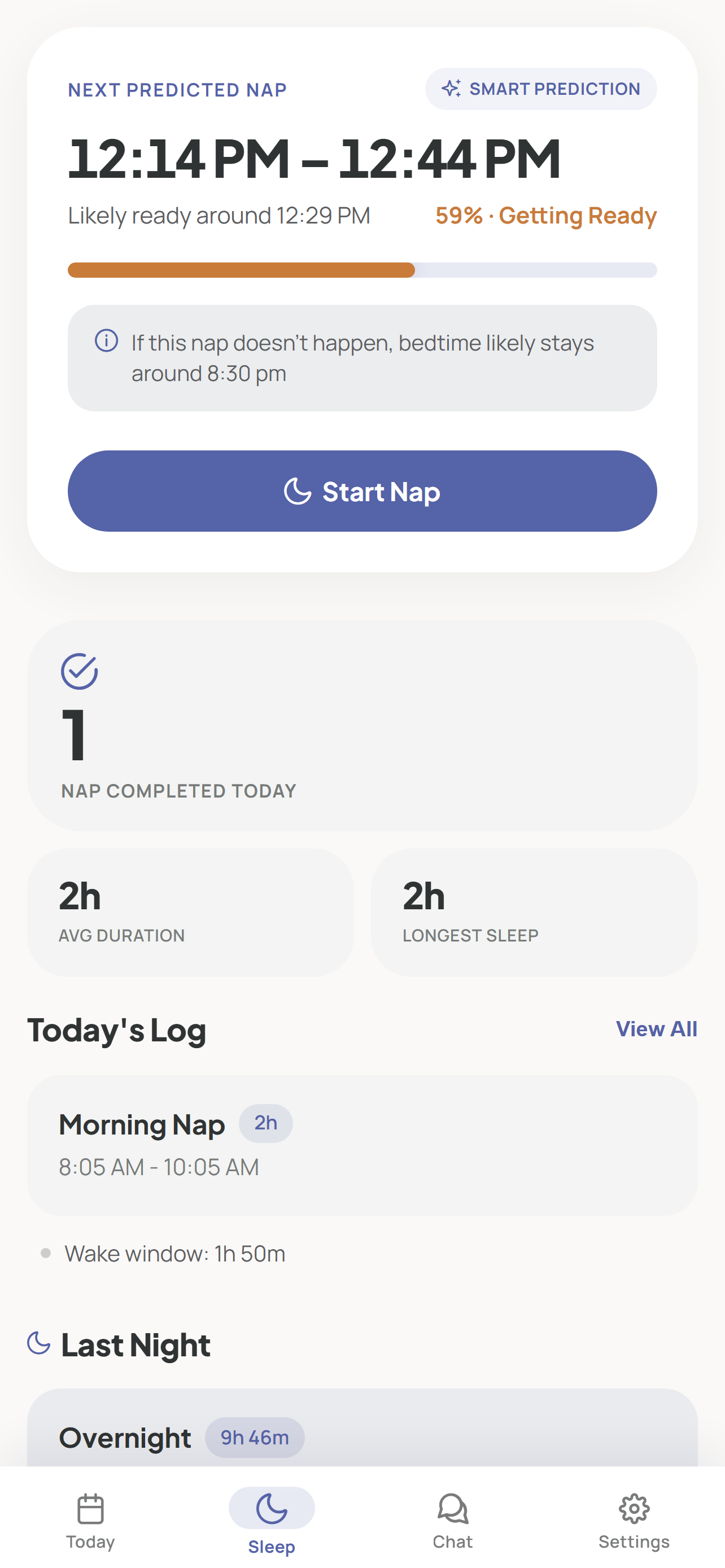
LunaLog notices when the naps you log stop matching the schedule — and adjusts the next nap prediction and bedtime to the day you're actually having, not the one on the chart. Free to start, and both parents see the same plan.
Try LunaLog free