The default 14-month day is still two naps: roughly 95 minutes from about 9:50 and 85 minutes from about 2:30, with wake windows of about 3 hours after waking, a little over 3 in the middle, and 3.5 hours before a 7:15–7:30 PM bedtime. Around 3 hours of day sleep plus 10–11 hours at night keeps the total inside the 11–14 hour range for this age.
What changes is the margin. Two naps only fit if the afternoon nap ends by about 4:00 PM, and a toddler whose morning stamina keeps growing will start pushing that nap later and later. That squeeze — not a single skipped nap — is what a real 2→1 signal looks like. This page is a checklist for reading it, because the cost of guessing wrong runs both ways: transition too early and you get a chronically overtired toddler; too late and you get 45-minute bedtime battles from a child who just isn't tired.
The 2→1 readiness checklist
You're looking for a pattern that holds for 10–14 consecutive days, not a streak of three bad afternoons. Tick these:
- One nap consistently refused — usually the afternoon one — for 10–14 days, with the toddler staying reasonably cheerful through the longer stretch.
- The morning nap is pushing the afternoon nap past 3:30 PM, so either bedtime slips or you're waking a sleeping child to protect it.
- 45+ minutes to fall asleep at one nap or at bedtime, calmly, night after night — playing, singing, not distressed.
- Age at least 14–15 months. Before that, even a clean streak is more likely a phase than a transition.
Three or four ticks for two weeks means it's time to start the shift — pushing the morning nap later in 15–30 minute steps, with an early bedtime as the safety net. One tick means hold.
False signals: illness, travel, a molar
The same fortnight can produce identical symptoms for reasons that have nothing to do with readiness. A cold or ear infection shortens naps and stretches settling; anything with fever, breathing changes or poor feeding is a pediatrician conversation, not a schedule one. Travel — new room, time-zone shift, grandparents — wrecks the second nap for days and recovers within a week of getting home. A first molar breaking through does the same for two or three days, with drooling and gum-chewing as the giveaway.
The test is what happens when the disruptor lifts. If two naps snap back into place once the cold clears or the tooth is through, the checklist was never really ticked. If refusal continues for another two weeks in a healthy, settled toddler, it was real. Either way, nothing is lost by waiting — a false 2→1 costs weeks of overtiredness; a delayed one costs nothing.
Schedules are averages.
Your baby isn't.
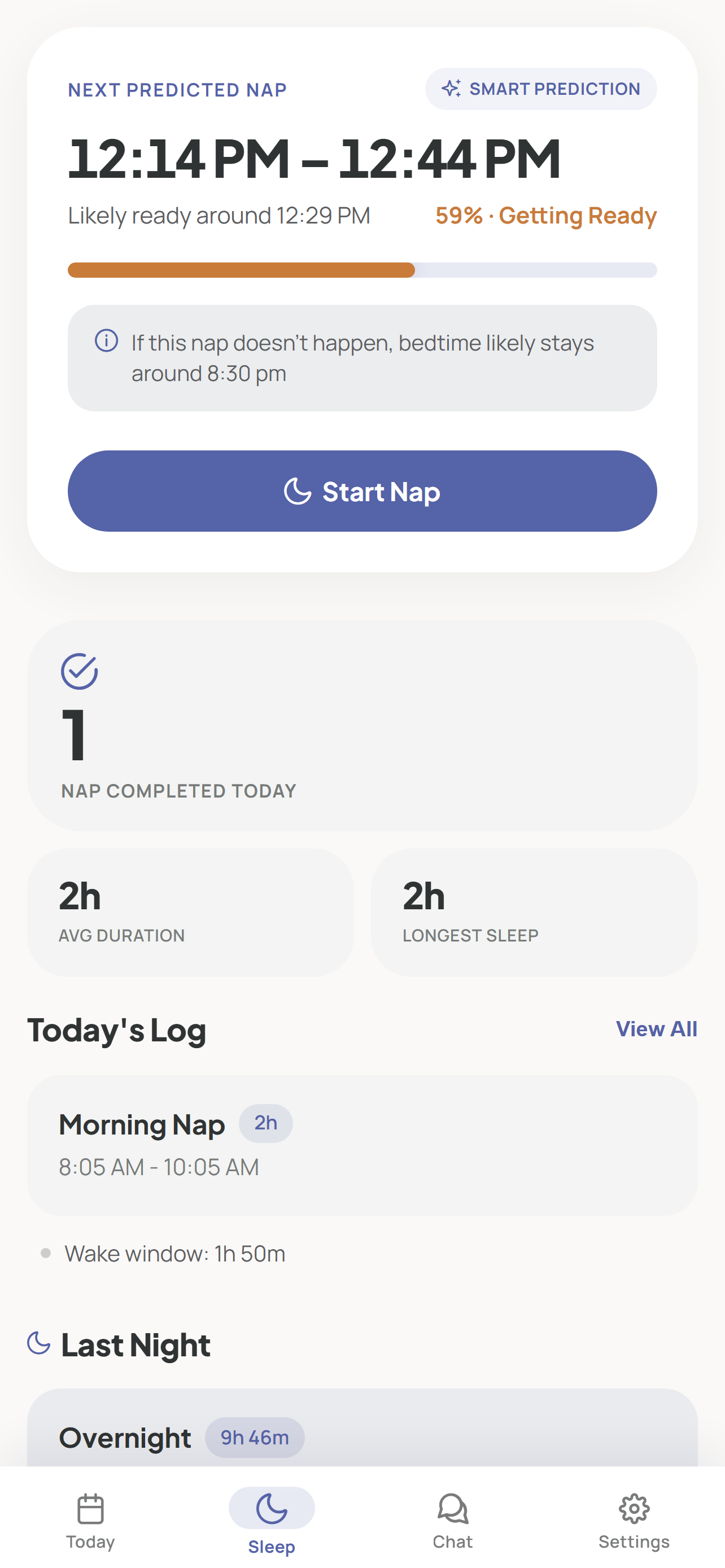
LunaLog learns your baby's actual rhythm from the naps you log and predicts the next nap window automatically — no mental math, and it updates itself as wake windows grow. Free to start, and both parents stay in sync in real time.
Try LunaLog free