At one month, sleep still totals 15–16 hours across 5–6 naps and the night, but the shape is starting to change: one night stretch pulls ahead of the others, and the day begins to have a loose rhythm of feed → short awake time → sleep. Wake windows sit at 45–75 minutes; the longest one is often before the night sleep, which is why the evening feels like the hardest part of the day.
You still cannot schedule a four-week-old. You can start giving the body clock its two strongest cues: bright, ordinary days and dark, dull nights.
Nudging day and night apart
- Naps happen in daylight and household noise. Do not black out the room for daytime sleep yet — that comes at 3–4 months, when naps need protecting.
- Night feeds are boring. Dim light, minimal talking, no play, back down straight after the burp.
- Get outside in the morning. Ten minutes of daylight before noon is the strongest circadian signal there is.
- Cap the marathon day nap. If a daytime nap passes 2.5–3 hours, wake for a feed so the long stretch migrates to nighttime (confirm with your pediatrician for your baby's weight).
Where the "schedule" comes from later
Every predictable rhythm your baby will have at four months grows out of the first wake-up of the day. Notice roughly when your baby wakes for good most mornings; over the next several weeks that time becomes the anchor, and the first nap becomes the first thing that fixes itself relative to it. You do not need to enforce anything — just notice, and log it if you can, so you see the pattern when it appears.
Schedules are averages.
Your baby isn't.
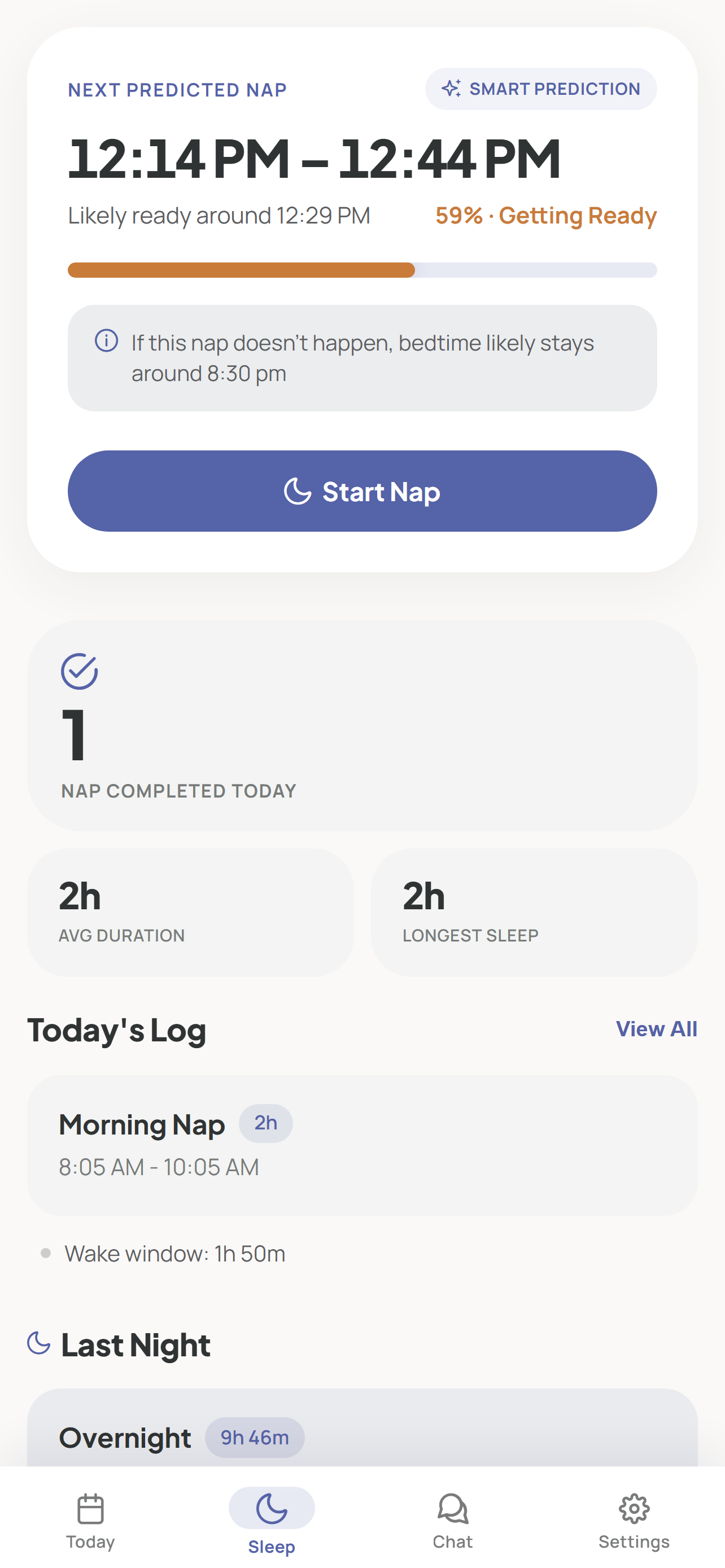
LunaLog learns your baby's actual rhythm from the naps you log and predicts the next nap window automatically — no mental math, and it updates itself as wake windows grow. Free to start, and both parents stay in sync in real time.
Try LunaLog free