The last nap does not drop; it fades. Somewhere between 3 and 5 years — later than most parents expect — the nap gets harder to fall into, starts pushing bedtime late, and eventually is refused more days than it is taken. The transition itself typically spans two to three months of alternating nap days and no-nap days, and the family that does it well has two tools: an early bedtime on no-nap days, and a quiet-time routine that replaces the nap in the schedule without replacing it in the child's body.
The common mistake is dropping the nap at 2 or 2½ because of nap resistance. At that age resistance is developmental — independence, imagination, a big bed — and the sleep need is still there. A 2-year-old who skips the nap and is fine at 5 PM is rare; one who is fine at 5 PM and a disaster at 6 is normal, and still needs the nap.
Doing the transition
- Alternate, don't switch. Nap days and no-nap days will mix for weeks. On a no-nap day bedtime is 6:30–7 PM; on a nap day, keep the nap capped at ~60–90 minutes and bedtime at 7:30–8 PM.
- Read the afternoon, not the morning. A child who was "fine without a nap" until the 5 PM meltdown is not ready. One who is genuinely okay through dinner on most no-nap days is.
- Move the nap earlier before you drop it. A 12:00 nap that ends by 1:30 protects bedtime better than a 1:30 nap during the fade.
- Expect an early-bedtime phase of 1–3 months after the nap is gone, with bedtime gradually drifting back to 7:30–8 PM as stamina builds.
Quiet time: the replacement
Quiet time is the nap's slot without the sleep: same time every day (right after lunch), same place (their room), 45–60 minutes, books and quiet toys, a clock or timer that marks the end so you are not the enforcer. It gives a no-nap child a genuine rest, gives you a break, and — crucially — keeps the option of falling asleep open on days the body needs it. Start it well before the nap fades (2½ is not too early to introduce it on the odd skipped-nap day) so it is a familiar routine, not a new rule, when you need it every day.
The no-nap day
Once the nap is gone the day is simple: wake around 6:30–7 AM, quiet time after lunch, dinner early, and bedtime as early as 6:30 PM at first, settling toward 7–7:30 PM after a few months. Total sleep for a 3–5-year-old is 10–13 hours, and with no nap all of it has to come at night — which is why the early bedtime is not optional in the first months. If night sleep is 11 hours and bedtime is 7 PM, the morning wake lands at 6 AM; move bedtime later only when the mornings prove it is safe.
A sample day
Before: the 1-nap day (2½–3 years)
Sample days assume a 7:00 AM wake-up. Customize for your baby's wake time →
Transitions are messy.
Your tracker shouldn't be.
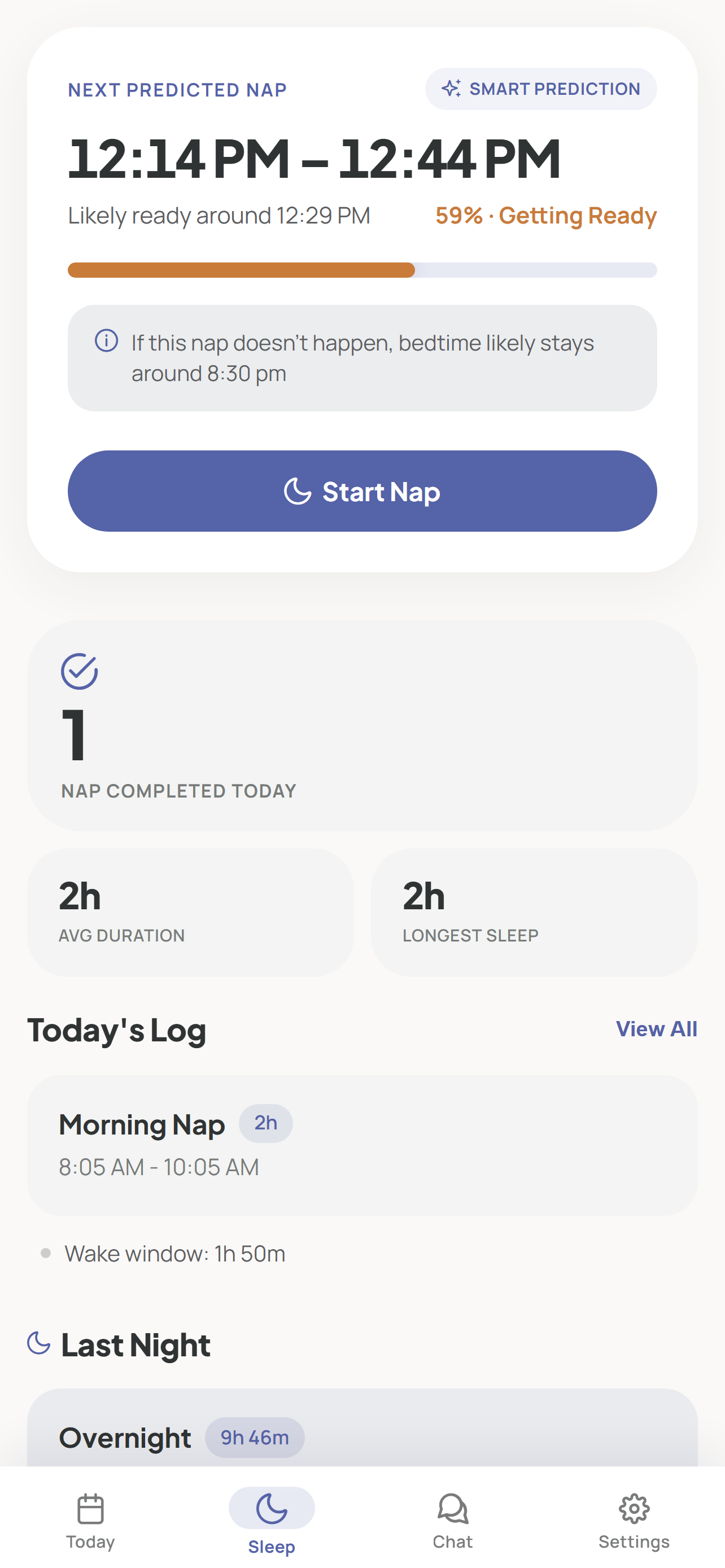
LunaLog notices when the naps you log stop matching the schedule — and adjusts the next nap prediction and bedtime to the day you're actually having, not the one on the chart. Free to start, and both parents see the same plan.
Try LunaLog free