Nap transition guide · 7–9 months

The 3→2 Nap Transition

Usually between 7 and 9 months. Here is how to tell a real transition from a bad week — and how to make the switch.

Is it time? The signs

  • The third nap (the late-afternoon catnap) is refused or takes 20+ minutes of protest, most days for 1–2 weeks
  • Naps 1 and 2 have lengthened and the catnap is pushing bedtime past 8 PM
  • Wake windows have stretched to 2.5–3 hours without meltdowns
  • Your baby is at least 7 months old

General guidance based on typical development — not medical advice. Illness, reflux and breathing concerns are always a pediatrician conversation.

The 3→2 nap transition is the second nap drop and, for most families, the easiest — because the nap being dropped is a 30–45 minute catnap whose only job was protecting bedtime. It happens between 7 and 9 months for most babies, once wake windows reach about 2.5–3 hours and the two main naps have lengthened enough to carry the day.

The trap is dropping it too early. A 6-month-old who refuses the catnap for three days is usually teething, sick, or overtired — not ready. The signs below are about consistency, not one bad afternoon.

Making the switch

  • Week 1–2: stretch, don't drop. Push the first two wake windows out by 15 minutes every few days until the second nap ends around 3–3:30 PM. Keep offering the catnap; let it be refused.
  • Use bedtime as the shock absorber. On a no-catnap day, bedtime moves to 6:30–7 PM. That is not "too early"; it is the whole mechanism.
  • Expect mixed weeks. Two-nap days and three-nap days will alternate for two to three weeks. Both are correct on the day they happen.
  • Cap the catnap when it does happen at 30 minutes, ending by 4:30 PM, so it never eats the night.

Transition or a bad week?

A real transition shows up as a pattern: the catnap is fought most days for two weeks, while the first two naps are solid and the baby is cheerful through longer windows. A bad week shows up as everything being worse at once — short naps, early waking, night waking — usually with a cause (a tooth, a cold, a trip, a leap). If naps 1 and 2 are also falling apart, it is not the transition; hold the three-nap day, shorten wake windows slightly, and revisit in a week or two.

The new 2-nap shape

Once the catnap is gone the day settles into a recognizable pattern that will last until 13–18 months: a morning nap about 2.5–3 hours after waking, a longer afternoon nap about 3 hours after that, and a final wake window of 3–3.5 hours to a 7–7:30 PM bedtime. The afternoon nap becomes the important one; over the coming months it grows while the morning nap slowly shrinks, which is the setup for the next transition.

Before and after: sample days

Before: the 3-nap day (6–7 months)

Wake windows2 hrs–2h 20m
Naps3
Day sleep~4 hrs
Bedtime7:45 PM
7:00 AMWake up for the day
Awake — 2 hrs of play, feeds & fresh air
9:00 AM – 10:30 AMNap 11h 30m
Awake — 2h 10m of play, feeds & fresh air
12:40 PM – 2:10 PMNap 21h 30m
Awake — 2h 15m of play, feeds & fresh air
4:25 PM – 5:25 PMNap 31 hr
Wind down — 2h 20m until bedtime
7:45 PMBedtimeOvernight sleep until morning

After: the 2-nap day (8–9 months)

Wake windows2h 50m–3h 30m
Naps2
Day sleep~3 hrs
Bedtime7:30 PM
7:00 AMWake up for the day
Awake — 2h 50m of play, feeds & fresh air
9:50 AM – 11:25 AMNap 11h 35m
Awake — 3h 10m of play, feeds & fresh air
2:35 PM – 4:00 PMNap 21h 25m
Wind down — 3h 30m until bedtime
7:30 PMBedtimeOvernight sleep until morning

Sample days assume a 7:00 AM wake-up. Customize for your baby's wake time →

Transitions are messy.
Your tracker shouldn't be.

LunaLog notices when the naps you log stop matching the schedule — and adjusts the next nap prediction and bedtime to the day you're actually having, not the one on the chart. Free to start, and both parents see the same plan.

Try LunaLog free
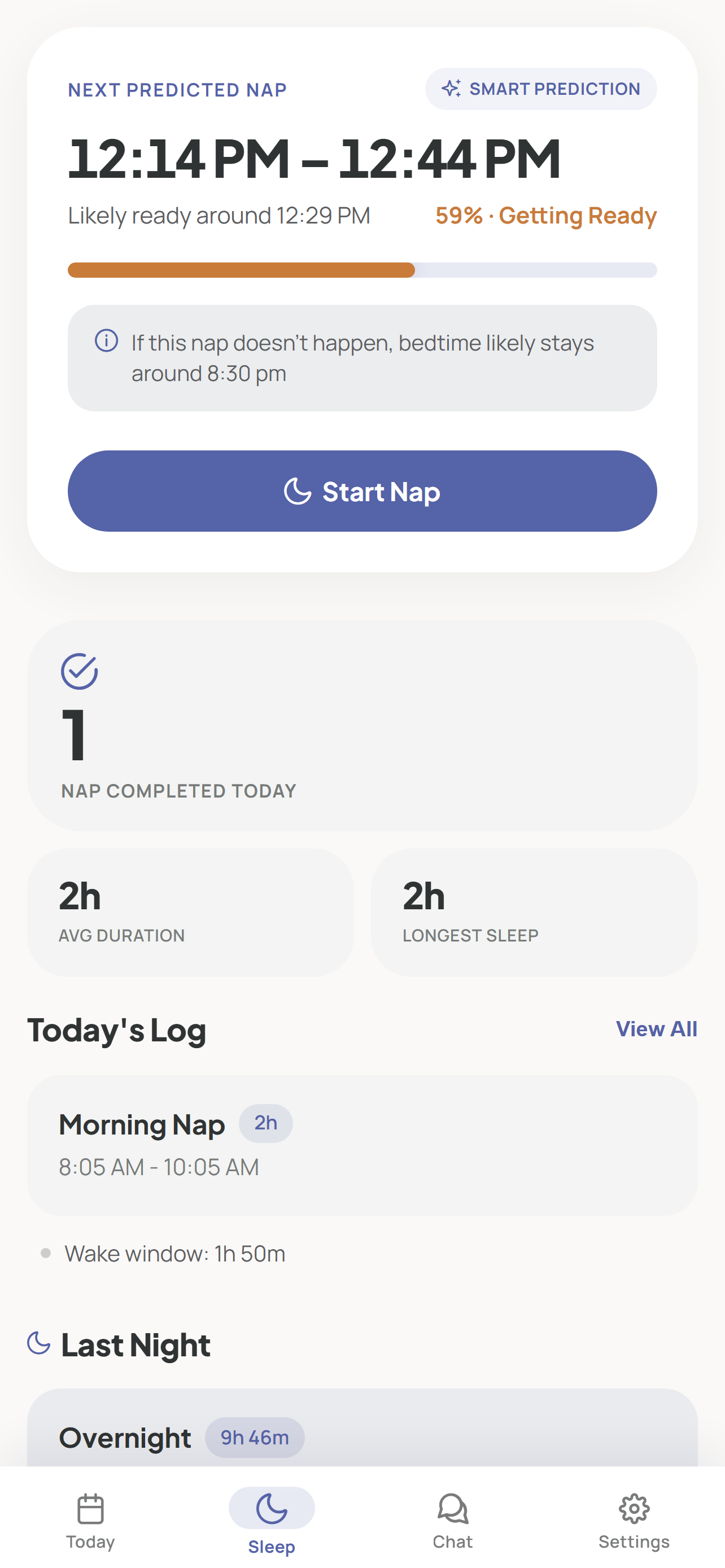
LunaLog app predicting a baby's next nap window

Nap transition questions

When do babies drop the third nap?

Usually between 7 and 9 months, when wake windows reach about 2.5–3 hours. Some babies do it at 6 months and some hold three naps until 10; readiness signs matter more than the calendar.

How long does the 3 to 2 nap transition take?

Typically two to three weeks of mixed days, with the two-nap days gradually winning. Early bedtimes on no-catnap days are what make the mixed weeks survivable.

Should I drop the third nap if my baby is fighting it?

Only if the fight is consistent for one to two weeks AND the first two naps are solid. If everything is going badly at once, it is usually teething, illness or overtiredness — keep the catnap and revisit later.

What time should bedtime be after dropping to 2 naps?

Around 7–7:30 PM on a normal day, and as early as 6:30 PM on a day when the second nap ended early or was short. An early bedtime does not cause early waking at this age; overtiredness does.

Stop counting minutes.
Start predicting naps.

LunaLog tracks the day for you and tells you when the next nap is coming — free to start.

Also on the web at app.lunalog.io · No credit card required